PPM Health Alert | Cyclospora Outbreak: What Shoppers Need to Know Before Buying Fresh Produce
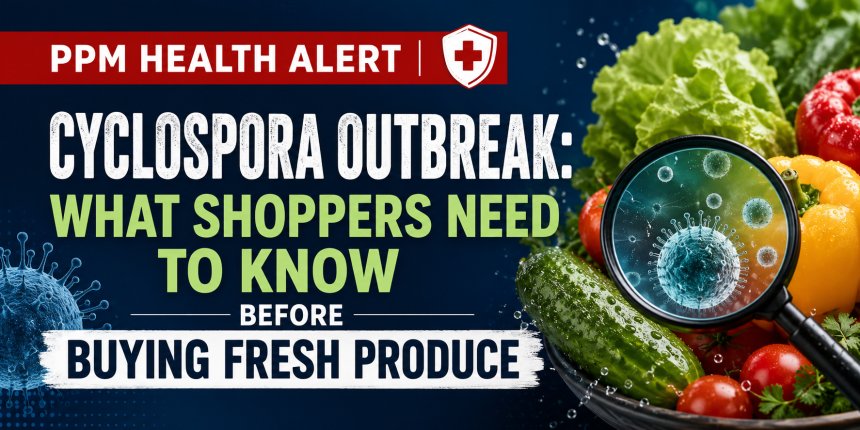
PPM Health Alert | Cyclospora Outbreak: What Shoppers Need to Know Before Buying Fresh Produce
Category: Health & Wellness
By: Maya Brooks, Health & Wellness Writer
Editor's Note
A growing Cyclospora outbreak is making headlines across the United States, leaving many shoppers wondering whether it's still safe to eat fresh fruits and vegetables. Here's what health experts know so far—and what you can do to lower your risk without giving up healthy eating.
A Growing Food Safety Concern
Health officials across the United States are investigating a widespread outbreak of Cyclospora, a microscopic parasite that causes cyclospora infection (cyclosporiasis). The illness primarily affects the digestive system and has been linked to contaminated fresh produce. Federal investigators continue working to identify the exact source, but no single grower, brand, or supplier has been confirmed at this time.
What Is Cyclospora?
Cyclospora (Cyclospora cayetanensis) is a parasite that can contaminate food or water through poor sanitation practices.
Common symptoms include:
- Watery diarrhea
- Loss of appetite
- Stomach cramps
- Nausea
- Fatigue
- Bloating
- Weight loss
- Low-grade fever (in some cases)
Symptoms usually appear about one week after exposure and can last for several weeks if left untreated. Most cases respond well to prescription antibiotics.
Is Any Produce Completely Safe?
According to infectious disease experts interviewed by Newsweek, there is currently no raw fruit or vegetable that can be considered completely immune from Cyclospora contamination. The risk depends more on how produce is grown, handled, and washed than on the fruit or vegetable itself.
That doesn't mean consumers should stop eating produce.
Instead, experts recommend taking extra precautions while the investigation continues.
Produce Previously Linked to Cyclospora Outbreaks
Past outbreaks have involved foods such as:
- Bagged salad mixes
- Lettuce
- Cilantro
- Basil
- Green onions
- Snow peas
- Raspberries
Investigators are currently examining lettuce as one possible source in parts of the country, but no official nationwide recall or confirmed food source has been announced.
Lower-Risk Choices
Experts say produce with thick protective skins may carry a lower risk because consumers remove the outer surface before eating.
Examples include:
- Bananas
- Oranges
- Avocados
- Pineapples
- Melons
These should still be washed before peeling to avoid transferring contamination from the skin to the edible portion.
How to Reduce Your Risk
Health experts recommend:
Wash fruits and vegetables thoroughly under running water.
Wash your hands before preparing food.
Clean cutting boards, knives, and countertops.
Wash firm produce with a clean produce brush.
Remove damaged portions of fruits and vegetables.
Cook vegetables whenever possible, as heat reliably kills the parasite.
Keep in mind that washing helps reduce risk but does not guarantee removal of Cyclospora. Cooking remains the most effective protection.
Should You Stop Buying Produce?
At this time, public health officials are not recommending that Americans stop eating fruits and vegetables.
Instead, they're encouraging consumers to continue eating a healthy diet while following proper food safety practices until investigators determine the outbreak's source.
PPM Takeaway
Fresh fruits and vegetables remain an important part of a healthy lifestyle. While the Cyclospora investigation continues, the best approach is awareness—not panic.
Practice safe food preparation, stay informed through official health updates, and seek medical attention if you experience persistent diarrhea or signs of dehydration after eating fresh produce.
Original Reporting Credit
Newsweek
"List of Fruits and Vegetables That Are Safe From Cyclospora Parasite" — Newsweek.
Additional reporting and fact verification by Power Pulse Magazine, using information from the CDC, FDA, and current public health reporting.
PPM Disclaimer:
This article is intended for informational and educational purposes only and should not be considered medical advice. Information was researched using publicly available health guidance and verified reporting. AI-assisted research supported the editorial process, and all content was reviewed and edited by a human editor. Creative direction by Power Pulse Magazine.
Share
What's Your Reaction?
 Like
0
Like
0
 Dislike
0
Dislike
0
 Love
0
Love
0
 Funny
0
Funny
0
 Angry
0
Angry
0
 Sad
0
Sad
0
 Wow
0
Wow
0